
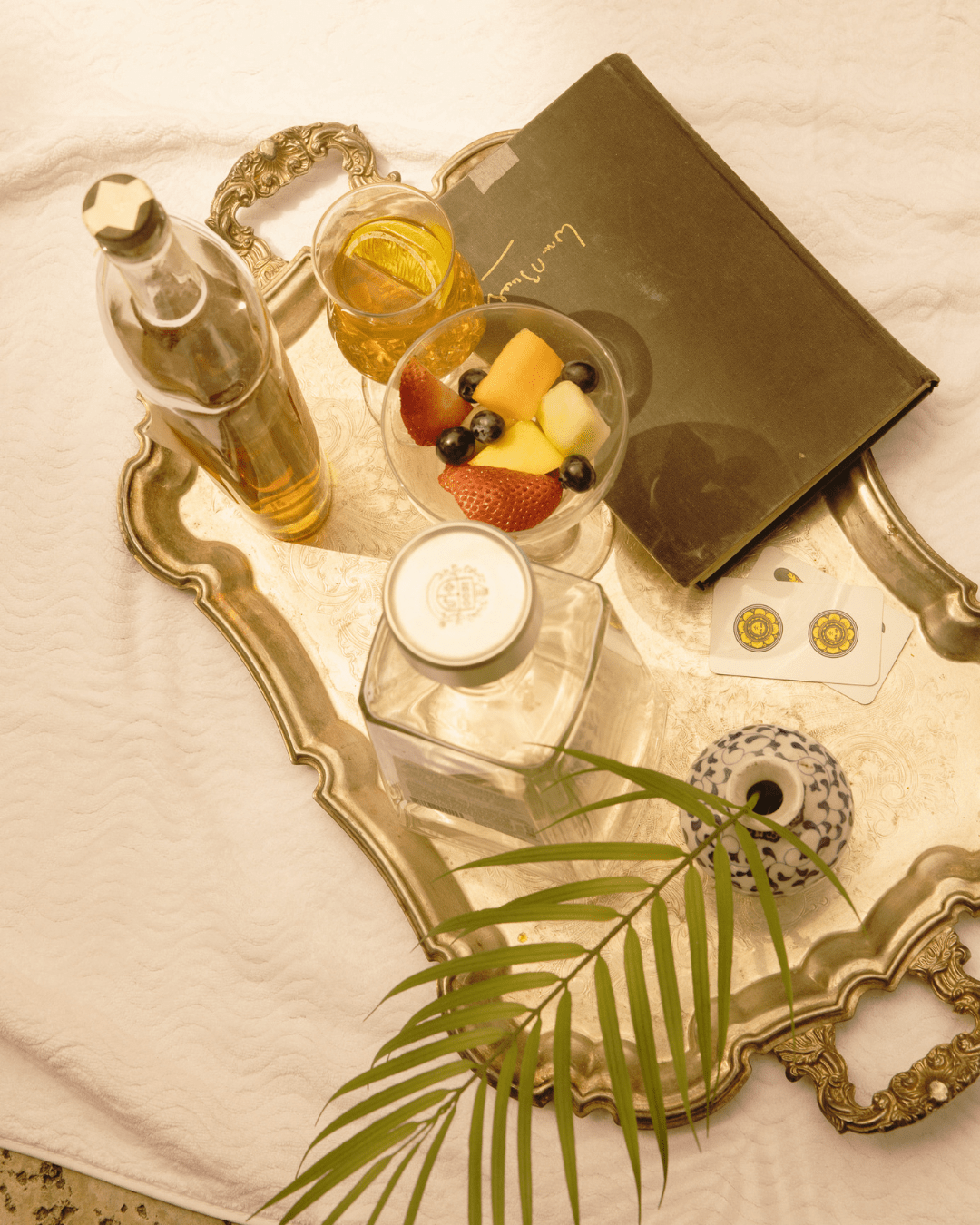
At a certain hour in Italy, the day loosens its collar. Shop doors remain open, scooters continue their negotiations with traffic, and the sun lingers on stone facades as though it has nowhere more pressing to be. Then the glasses appear. A shallow bowl of olives lands on the table. Someone orders something orange, red, or clear enough to catch the light. Dinner is still a distant concern. For the moment, there is aperitivo.
The word comes from aperire, Latin for "to open." Originally, an aperitivo was understood quite literally: a bitter or aromatic drink meant to open the appetite. But the Italians, with characteristic good judgment, expanded the idea. What began as preparation for a meal became a ritual of its own: a small, civilized border between obligation and pleasure.
That border matters. Modern life is efficient at eliminating transitions. We leave work while still answering it, arrive home while still commuting in our minds, and sit down to dinner with the day clinging to us. Aperitivo insists on an intermission. It does not ask whether the day was successful. It merely suggests that it is over enough to begin enjoying.
The custom took recognizable form in the cafes of northern Italy. In Turin, vermouth emerged in the late eighteenth century as an aromatized wine infused with herbs, roots, and spices. In Milan, Gaspare Campari created his vivid bitter in 1860, later serving it from Caffe Campari beneath the glass vaults of the Galleria Vittorio Emanuele II. By 1915, Camparino had opened across the arcade, helping establish the Milanese bar as a stage for the evening ritual. Padua contributed Aperol in 1919, after the Barbieri brothers spent years refining a lighter, citrus-forward bitter that would eventually glow from terraces around the world.
These drinks share a useful quality: bitterness. Sweetness flatters immediately; bitterness takes its time. It wakes the palate, invites another sip, and makes a few salted almonds seem unusually important. Aperitivo was never designed to overwhelm the evening. Its drinks tend to be lengthened with soda, wine, or sparkling water, leaving enough composure for dinner and enough conversation to make one late for it.
The spritz may be the most recognizable expression of the ritual, but it is hardly the only one. There is the Americano - Campari, sweet vermouth, and soda - whose name is often attributed to the American travelers who favored it. There is the Negroni, born when Count Camillo Negroni supposedly asked for his Americano with gin instead of soda, a decision of questionable restraint and excellent consequence. There is a simple glass of white wine, a vermouth over ice, a beer, or even a bottle of mineral water with lemon. Aperitivo is defined less by the contents of the glass than by the pace at which it is emptied.
The food follows the same philosophy. Olives, crisps, anchovies, small sandwiches, shards of cheese, perhaps a plate of focaccia cut into squares. Nothing should resemble a commitment. The objective is to sharpen the appetite, not defeat it. In Venice, this logic appears in cicchetti: small bites served in bacari, the city's intimate wine bars. One might have a crostino topped with salt cod, a fried meatball, or a wedge of something marinated, followed by an ombra - a small glass of wine. The portions are modest so the afternoon can remain ambitious.
Elsewhere, the custom can grow more generous. Milan helped popularize apericena, a hybrid of aperitivo and cena, where the accompanying spread becomes substantial enough to cancel dinner altogether. Purists may object. They are probably correct. Still, every ritual eventually attracts an overachiever, and a buffet is one way of discovering that one has accidentally eaten dinner while waiting for it.
Yet the true ingredient is company. Aperitivo is social without being ceremonial. It asks for no seating chart and no important bottle saved for an important year. Friends may join late. Plans can change. One drink becomes two, then a decision is made about dinner, or perhaps no decision is made at all. The evening gathers itself gradually, which is generally how the best evenings do.
There is also a democratic quality to the hour. The ritual belongs equally to the polished hotel bar, the neighborhood cafe, and the folding table outside a tiny coastal grocery. Its elegance comes not from expense but from attention: the right temperature, a bowl of something salty, a chair angled toward the street, a little time reserved for no measurable outcome.
This may be why aperitivo has traveled so well. It offers more than a cocktail recipe. It offers architecture for leisure. Any place can adopt it because the requirements are forgiving: a drink that encourages rather than concludes, something small to eat, and the discipline to begin before hunger turns the occasion into dinner. Sunlight helps. Linens don't hurt.
The hour is particularly persuasive in summer. Heat makes productivity feel faintly unreasonable, and the late light extends permission to remain outside. Glasses sweat on marble tables. Citrus peels brighten the air. The streets perform their evening shift change as offices empty and restaurants prepare. Aperitivo occupies the interval, making a destination of the time most cultures hurry through.
Perhaps that is its most enduring lesson. Leisure does not always require an empty calendar, a distant coast, or a heroic amount of free time. Sometimes it needs only a threshold. A clear signal that one part of the day has ended and another has begun. The Italians found that signal in a bitter drink, a few olives, and an hour that refuses to explain its usefulness.

Share:
LEISURE LETTER 054: Beyond The Margarita
LEISURE LETTER 056: THE LOST ART OF THE HOTEL BAR