
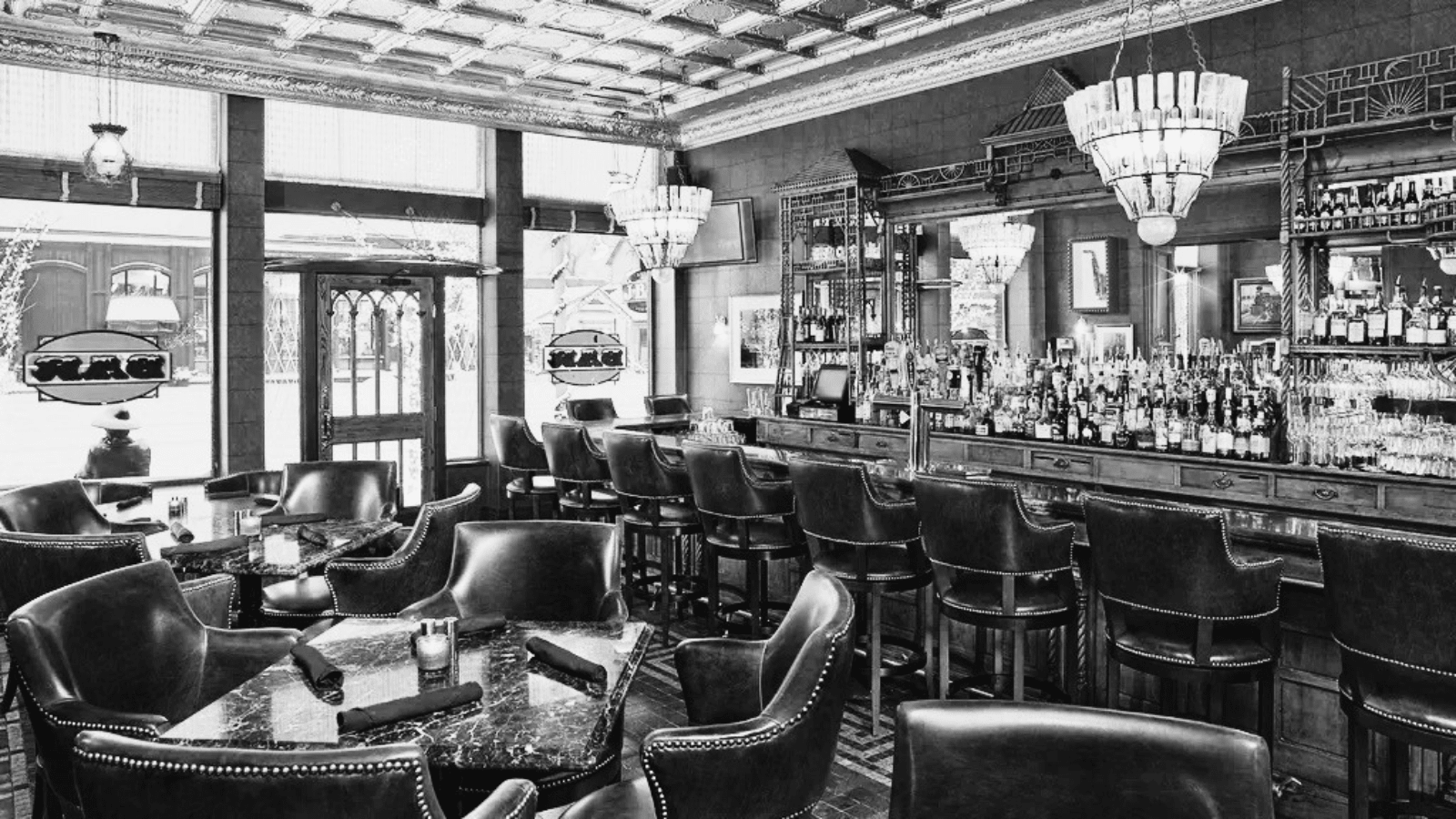
Every worthwhile hotel bar begins with a small deception. It pretends to be a public room, but behaves like a private one. The doors are open and the stools are unclaimed, yet the moment you sit down the city seems to recede. Luggage disappears upstairs. Appointments become tomorrow's concern. A stranger at the far end of the counter may be a diplomat, a drummer, a divorce attorney, or simply someone who has ordered well. No one asks, and that's part of the arrangement.
The hotel bar was built for people in transit, which may explain why it has always felt unusually permanent. Railway stations hurry you onward. Airports remind you what time it is in three different cities. The hotel bar asks only whether you would prefer a twist or an olive. It is a waiting room relieved of urgency, a place where arrival and departure briefly agree to leave you alone.
Its ancestry is practical. Taverns once offered drink, food, and a bed under the same roof, serving as both shelter and public square. By the nineteenth century, as grand hotels rose in growing cities, the bar moved indoors and upward in status. It became a polished room for travelers, businessmen, foreign correspondents, and anyone with enough confidence to enter a lobby without a reservation. The local saloon belonged to the neighborhood. The hotel bar belonged to the world.
That distinction mattered. A hotel could import a little of everywhere: French service, American ice, Caribbean rum, Italian vermouth, British gin, a pianist from somewhere with colder winters. Behind the bar sat the ingredients of international life, arranged in bottles. A drink ordered in London might have been invented in New Orleans, perfected in Havana, and served by a bartender who learned the recipe in Paris. Globalization was considerably more charming when it arrived on a silver tray.
The great hotel bars understood that atmosphere was not decoration. It was the principal ingredient. At the American Bar in London's Savoy, bartenders turned hospitality into theater and cocktails into signatures. At Raffles in Singapore, the Long Bar gave the world the Singapore Sling in 1915, a tropical drink devised with enough fruit and color to pass, in its day, as something more socially innocent. At New Orleans' Hotel Monteleone, Walter Bergeron created the Vieux Carre in 1938; eleven years later, the hotel introduced a revolving Carousel Bar, because apparently a stationary drink had become too predictable.
New York supplied its own variations. The Algonquin gathered writers, critics, actors, and professional mischief-makers in a hotel dining room beginning in 1919. Their lunches produced gossip, grudges, jokes, and eventually part of the mythology of modern Manhattan. The hotel's Blue Bar arrived after Prohibition, but the underlying principle had already been established: a hotel is improved by people who have no intention of going to their rooms.
Uptown, Bemelmans Bar at The Carlyle opened in 1947 beneath murals painted by Ludwig Bemelmans, the creator of Madeline. Central Park animals skate, picnic, and misbehave across the walls while a pianist works through the Great American Songbook. The room is elegant without becoming solemn, which is a more difficult balance than most architects admit. It possesses what the best hotel bars have in abundance: a sense that interesting things have happened there, and that the furniture has agreed not to discuss them.
Discretion is the hotel's native language. A neighborhood bar tends to know who you are. A hotel bar is gracious enough not to care. You may be a regular, a guest, or someone sheltering from weather both literal and personal. The bartender does not require your biography. He may remember your order, which is far more useful. Anonymity, properly served, is not loneliness. It is freedom with a coaster beneath it.
This is why the hotel bar has so often attracted writers. It offers company without obligation and solitude without silence. One can observe without appearing idle, which is essential to anyone avoiding a deadline. The room provides characters, fragments of conversation, and the reassuring sight of other people making equally questionable use of the afternoon. A notebook on the bar suggests work. A second martini suggests revision.
Yet the old hotel bar has become increasingly difficult to find. Many new hotels have replaced it with a concept: a rooftop with a reservation system, a lobby fitted with laptops, a cocktail laboratory involving smoke, tweezers, and a paragraph of explanation. There is nothing wrong with invention. Bars should evolve, and some of the finest modern ones sit inside hotels. But spectacle is not the same as atmosphere, and a queue is rarely the beginning of leisure.
The classic room asked less of its guests. There was a proper bar, a few deep chairs, forgiving light, and music played at a volume that respected the possibility of conversation. Drinks arrived cold and recognizable. Snacks were salty. The staff understood that attentive service involves noticing when to appear and, more importantly, when not to. No one explained the evening to you. You were trusted to have one.
There was also a useful democracy to the place. A room upstairs might cost a week's wages, but the bar offered temporary citizenship for the price of a drink. You could enter beneath the same chandelier, sit beneath the same murals, and borrow the hotel's glamour for an hour. The best hospitality has always involved this little generosity: the feeling that the room is grand, but pleased you came.
Perhaps what has been lost is not the hotel bar itself, but the art of using one. We arrive with phones on the table, plans immediately afterward, and a suspicion that every room must justify itself through productivity. We photograph the cocktail before tasting it and search for the next place while still seated in the current one. The hotel bar was designed for a less efficient ambition: to remain.
To use one correctly, arrive slightly early. Sit at the bar unless the chairs are very good. Order something the bartender can make without consulting a torch. A martini, a highball, a Negroni, a glass of Champagne - the classics endure because they leave room for the room. Notice the pianist. Read the newspaper. Invent a harmless history for the couple by the window. Resist the urge to improve the moment by relocating it.
You need not be traveling. In fact, the local visit may be the purest form. Walk into a hotel in your own city and allow yourself the minor fiction of being elsewhere. You have no luggage, no wake-up call, and no obligation to learn the Wi-Fi password. For an hour, you are simply passing through. There are worse ways to remember where you live.
The lost art of the hotel bar is therefore not nostalgia for brass rails and burgundy carpet, though both have their uses. It is nostalgia for an interval: the civilized pause between the day one has had and the evening one might still deserve. It is the pleasure of being among strangers, attended to without being examined, in a room built to make time behave.
The hotel bar does not ask where you have been. It merely offers somewhere worth arriving.
Share:
LEISURE LETTER 055: The Afternoon Aperitivo